OK, so who had Pope Leo XIV versus President Donald J. Trump on their fight card, let alone bingo card?
Today, many shocked posters on the internet are saying they didn’t. But I did.
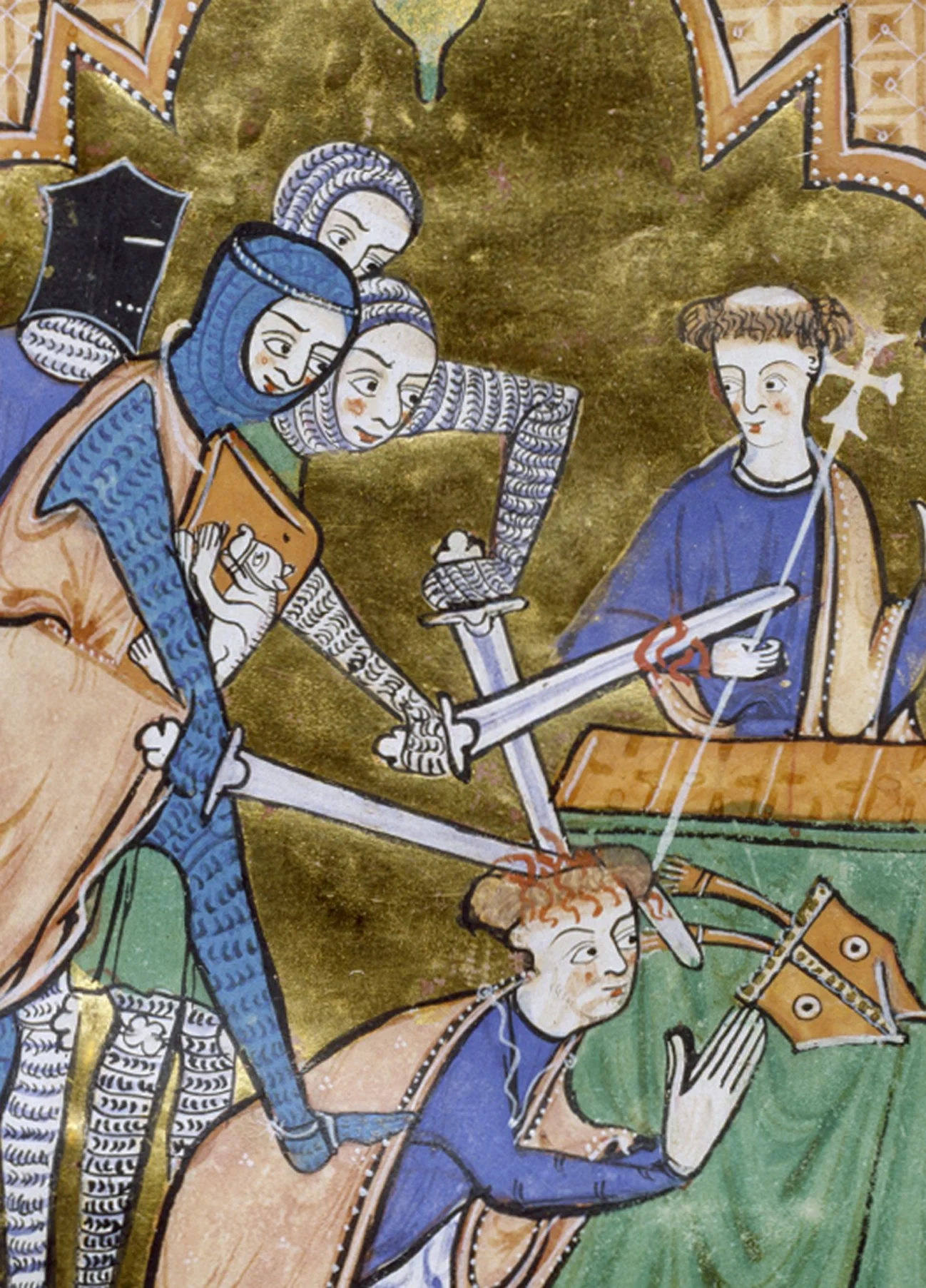
Read MoreA depiction of the murder of St. Thomas Becket by knights of his friend King Henry II of England. From the Carrow Psalter, 1250, ink, gold and parchment. Courtesy Walters Art Museum.
OK, so who had Pope Leo XIV versus President Donald J. Trump on their fight card, let alone bingo card?
Today, many shocked posters on the internet are saying they didn’t. But I did.
Read MoreChristmastide – which actually begins with the birth of Jesus and ends with his baptism – is also a time for commemorating martyrs. St. Stephen, considered by the Church to be the first martyr, is remembered on Boxing Day, Dec. 26, while Dec. 29 is the feast of St. Thomas Becket, archbishop of Canterbury, who was murdered in the cathedral there on Dec. 29, 1170 by the henchmen of the king he loved, Henry II. (The feast day is generally the day the saint died, not his or her birthday.)
Becket’s relationship with Henry, as you might imagine, was a complicated affair that has proved catnip to artists, filmmakers and writers like poet T.S. Eliot (“Murder in the Cathedral”). My favorite interpretation is Jean Anouilh’s Tony Award-winning play “Becket,” which became a highly entertaining movie starring Richard Burton and Peter O’Toole, who died just recently.
Anouilh had reimagined Sophocles’ “Antigone,” with its iconoclastic heroine, as a metaphor for the French Resistance. In “Becket,” he gives us a homosocial, if not homoerotic, account of a strong male bond broken by a lack of self-knowledge. Read more
Read MorePeter O'Toole in "Lawrence of Arabia"
Peter O’Toole, who died Saturday in London at age 81 after being ill for some time, was an expert at playing the men who played the games.
From T.E. Lawrence, who helped Arabia win its war but was outmaneuvered in trying to help it secure its peace; to Henry II, who manipulated his wife, Eleanor of Aquitaine, friend, Thomas Becket, and sons as if they were chess pieces; to old King Priam, not to proud to beg Achilles for the body of his son Hector, O’Toole left an indelible mark embodying men who had seen the worst of conflict but refused to yield the field. His Priam, a father who had lost a beloved son, on his knees before Brad Pitt’s Achilles, a son who would never see his father again, was the best thing about “Troy” – a reminder, as Nelson Mandela was in a different way, that enemies can put aside their differences for a greater good.
I had adored O’Toole since seeing him as the young Henry II to Richard Burton’s title character in the 1964 film of Jean Anouilh’s “Becket,” one of the great power “plays.” It’s a homosocial, if not homoerotic, story of a king who appoints his pal first chancellor of England and then Archbishop of Canterbury, the head of the church there, never understanding, as political theorist Michael Harrington once observed, that the job makes the man. Becket was happy to serve Henry until he got a boss with greater authority – God. The scene on the beach in which the two meet for the last time is one my sisters and I read and reread as children.
After that, I followed O’Toole’s career religiously, from some very funny performances (the “Topkapi”-like “How to Steal a Million” with Audrey Hepburn) to the deeply poignant (the title character in “Goodbye, Mr. Chips”). I even enjoyed his singing in the uneven but still stirring “Man of La Mancha.”
So I was delighted as a journalist to cover the press conference for “Troy.” Picture a room filled mostly with Web “reporters” who looked like Comic Book Guy from “The Simpsons.” Read more
Read More