OK, so who had Pope Leo XIV versus President Donald J. Trump on their fight card, let alone bingo card?
Today, many shocked posters on the internet are saying they didn’t. But I did.
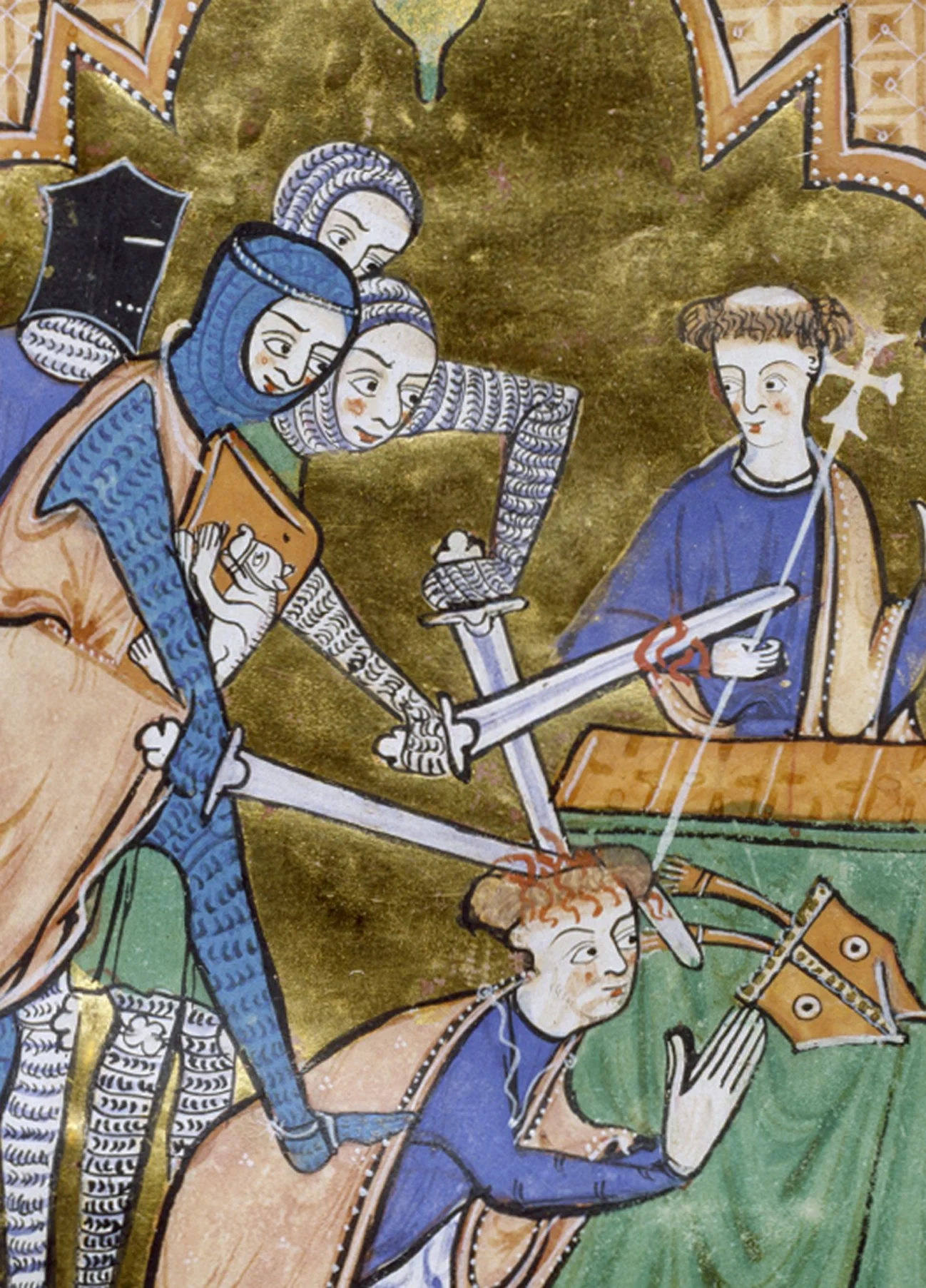
Read MoreA depiction of the murder of St. Thomas Becket by knights of his friend King Henry II of England. From the Carrow Psalter, 1250, ink, gold and parchment. Courtesy Walters Art Museum.
OK, so who had Pope Leo XIV versus President Donald J. Trump on their fight card, let alone bingo card?
Today, many shocked posters on the internet are saying they didn’t. But I did.
Read MoreThe gentlemanly surrender of British Gen. John Burgoyne to Patriot Gen. Horatio Gates after the Battle of Saratoga on Oct. 16, 1777, as depicted by John Trumbull in this 1818 painting, is how we tend to think of the American Revolution after the fact — nice and stately. Instead, it was a long, brutal guerrilla conflict, and though Saratoga would prove its turning point for the Patriots, it would still drag on for six more years.
Next year marks the United States’ 250th birthday and already plans are underway for the celebration, with the nonprofit America250 Commission https://america250.org/ charged with staging different events and programs to mark the occasion. (Each of the 50 states has also created its own commission, with plenty of cultural organizations contributing exhibits and performances.)
Though ostensibly bipartisan, America250 has come under the aegis of the Trump Administration, which wants to ensure that American history is portrayed in such a way that Americans don’t feel ashamed of their past. But Ken Burns – whose “The American Revolution” aired on PBS Nov. 16 through Nov. 21 and is streaming free there through Dec. 14 – has said in interviews that we owe it to ourselves to tell the truth about the revolution and let the chips fall where they may. Far from shaming us, Burns and producing partner Sarah Botstein have said, the revolution should inspire and enlighten us as ordinary citizens overcame seemingly insurmountable odds to buck the British Empire and create the world’s oldest modern democracy.
Read MoreThomas Lawrence’s “John Philip Kemble as Coriolanus” (1799, oil on canvas). Guildhall Art Gallery. William Shakespeare’s “Coriolanus,” about rivalries and shifting alliances, offers some insights and warnings for the Trump-Musk feud.
Those who think President Donald J. Trump and Elon Musk will make up, or staged their feud for effect, do not understand how narcissism works.
Read MoreFrom left, Ukrainian President Volodymyr Zelenskyy, American President Donald J. Trump and Vice President JD Vance in a heated exchange at the White House Friday, Feb. 28. Courtesy the White House.
As I’ve written many times on this blog — too many times but it bares repeating — there is much discussion of various “isms” when it comes to President Donald J. Trump, from communism to socialism, racism and sexism. But the only “ism” that matters is narcissism, and the failure to understand this prevents us from having any hope to dealing with him effectively.
Read MoreAlexei Navalny, who died in a Siberian prison Feb. `16, seen here in 2011. Photograph by Mitya Aleshkovsky.
Donald J. Trump is Alexei Navalny, haven’t you heard? And so is Julian Assange.
Indeed, just about anyone with an ax to grind who feels put upon is Navalny, the Russina opposition leader who died mysteriously in Siberia on Feb. 16 just as the Munich Security Conference, which wife Yulia Navalnaya attended, was underway and Russia was making headway in its war on Ukraine, thanks to the Republicans in the House of Representatives.
Read MoreGordon Parks’ 1946 photograph “American Gothic: Portrait of Government Cleaning Woman Ella Watson” plays off of Grant Wood’s iconic painting of the same name, stating in no uncertain terms that Watson’s contribution to American society was no less important or dignified than Wood’s dour White farmer and his wife. Courtesy Library of Congress Prints and Photographs.
Many years ago now, I interviewed Renaissance man Gordon Parks — photographer, composer, writer and film director (“Shaft”), a man whose photojournalism in the 1940s through ’70s captured both the civil rights movement and Hollywood.
Parks had grown up poor and Black in Kansas. I asked him what kept him from being embittered by poverty and racial prejudice. He said something that has stayed with me ever since and that I have thought about a lot in the past few weeks of war and other violence: “It’s easier to pick up a paintbrush than a gun.”
Read MoreJohn Hassall’s 1899 lithograph of John Martin-Harvey as Sydney Carton in “A Tale of Two Cities. Courtesy the Bibliothèque Municipale de Lyon.
Last summer on a very bad day, I attended the funeral of an affable, older relative whom I hadn’t seen in a long time. Distracted by problems at work, I made a wrong turn and arrived just as the priest was finishing the Gospel that is usually read at funeral Masses. In it, Jesus says, “I am the Resurrection and the life. Whoever believes in me. though he were dead, yet shall he live, and whoever so lives and believes in me shall never die” — complementary, mirror-image phrases, like so many throughout the New Testament, that Charles Dickens uses to brilliant effect in the denouement of his French Revolutionary novel of dissipation and redemption, “A Tale of Two Cities.”
Read More


