What do September, Labor Day, 9/11, tennis and Gen. Mark A. Milley, chairman of the Joint Chiefs of Staff, have in common?
One word, one four-letter word — work.
Read MoreGen. Mark A. Milley, chairman of the Joint Chiefs of Staff, in a 2019 command portrait,. Photograph by Monica King, United States Army.
What do September, Labor Day, 9/11, tennis and Gen. Mark A. Milley, chairman of the Joint Chiefs of Staff, have in common?
One word, one four-letter word — work.
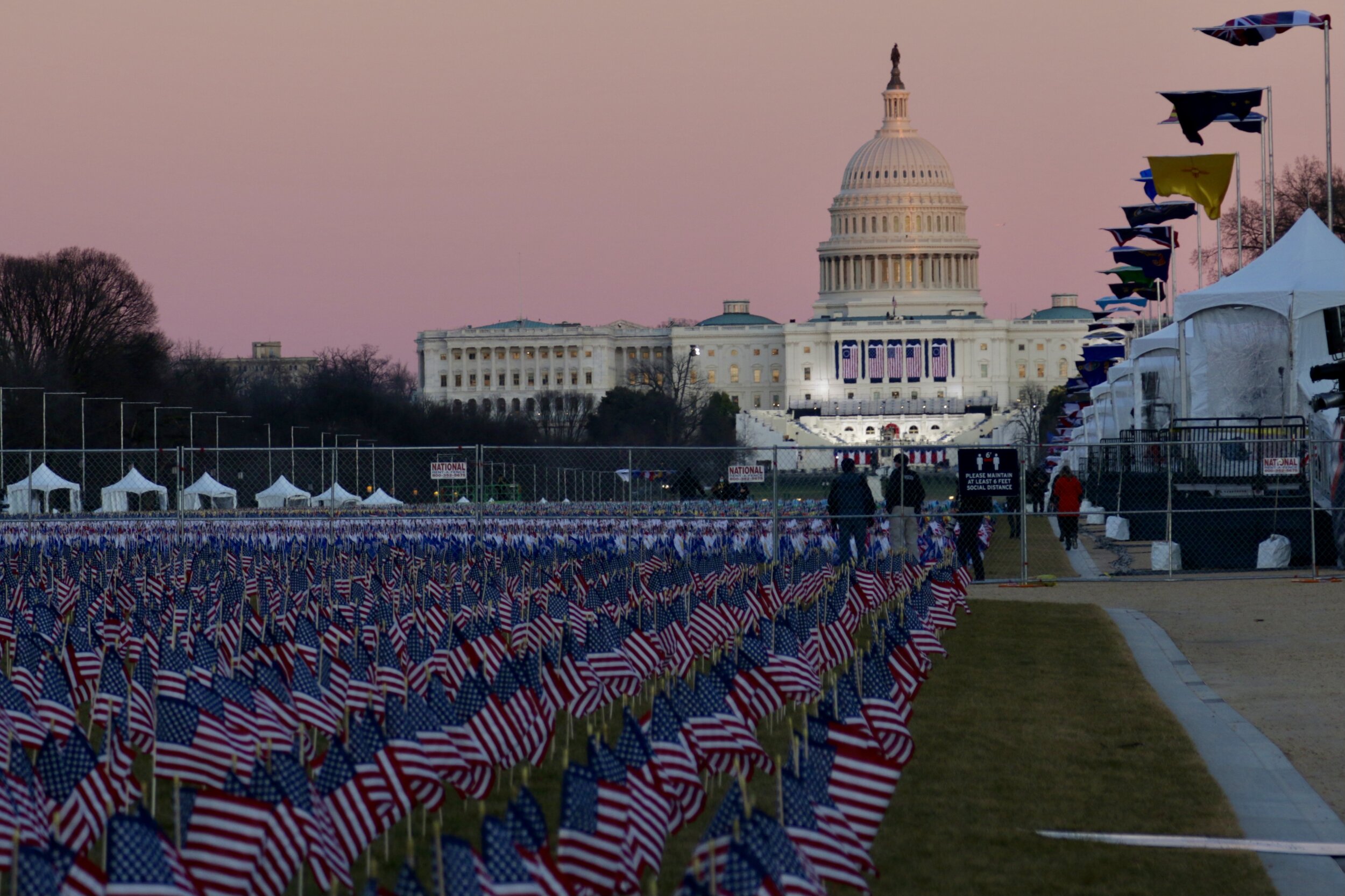
Read MoreStanding in for flag-waving attendees, flags unfurl on the National Mall before the inauguration of Joe Biden as the 46th president of the United States. Photograph by Brian Soward/U.S. Border and Customs Protection.
Something dies, and something is born, and the sunset begets the sunrise.
What died in the last two weeks — hell, in the last four years — was the idea of the American empire as the Trump Administration’s “America First” policy, which was really the “Donald J. Trump First” policy, absented America from the world stage even as the president himself assumed imperialistic trappings of Caligula- and Nero-like proportions.
Read MoreThe storming of the Capitol by Trump supporters has forced us all to put our cards face up on the table. It’s not a pretty hand. Photograph by Tyler Merbler.
The late comedian Red Skelton had a humble way with an audience but a wicked sense of humor about the rich and powerful. When tyrannical Columbia Pictures head Harry Cohn — the man who turned Margarita Carmen Cansino into Rita Hayworth and Marilyn Novak into Kim Novak — passed away, his funeral was well-attended, to which Skelton remarked, “It just goes to show you: Give the people what they want and they’ll turn out for it.”
Jan. 5, the people of Georgia turned out to send two Democrats — Jon Ossoff and the Rev. Raphael Warnock — to the United States Senate, giving the Dems a one-vote majority in that body.
Jan. 6, President Donald J. Trump’s cult followers turned out, too, taking four years of disproportionate white, working-class grievance to the Capitol, where they acted like thugs — disrupting the Electoral College vote counting that would once again certify Joe Biden as president-elect; running through hallways, banging on doors, stealing mail and podiums, breaking windows and furniture; and generally disrespecting the place and the people who work there as their actions led to four deaths and countless injuries. Of all the terrible images, the one I can’t get out of my head is of one of the MAGAts posing with his red MAGA hat on a statue. If someone did that in my house, I would say, “Hats are for closets. Yours will be handed back to you as soon as you leave.”
Read MoreDiana, Princess of Wales, and tenor Luciano Pavarotti at the concert “Pavarotti and Friends for the Benefit of the Children of Bosnia” in his hometown of Modena, Italy, in September 1995. Cut loose from the royal family, she had by then developed the elegantly economical look that crystallized her last years and our sense of a woman in full.
Winter, as Charles Dickens knew, is the season of ghosts. The holidays bring memories of those who are no longer with us, reminders of those who cannot grace our tables — never more so than during the pandemic when the table is often a table set for just one.
TV, too, the great American unifier and divider, plays a role in this with sad but uplifting holiday fare and series that reopen old wounds while underscoring that the past is never really over, because it is part of the continuum that informs the present and the future.
“The Crown,” Netflix’s addictive-as-potato-chips series about the British royal family, is now in its fourth season, which brings us to the Diana years and a reappraisal of her, her legacy and what went so horribly wrong. Why does Diana, Princess of Wales, haunt us still? More to the point, why do we still haunt her — for it is the living who haunt the dead, not the other way around.
Read MoreA tish, or gathering, of Hassidic Jews during the festival of Sukkot in Jerusalem in 2009. Hassids and some Roman Catholics are among the religious chafing at coronavirus restrictions. Photograph by permission of Eli Segal.
A federal judge has struck down an Orthodox Jewish group’s lawsuit against New York’s restrictions on worship in large groups during the pandemic. The number of virus cases is creeping up in the Northeast, the state is cracking down and religious groups, including some Roman Catholics, are upset at what they see as infringements on their religious freedoms, guaranteed under the Constitution.
No one wants to impede the practices of the religious. But we are in a health emergency, the fight of our lives in what one doctor told me is not just the story of the year but will turn out to be the story of this century. So why is it so hard for religious groups — which are, after all, supposed to be on the side of humanity — to comply? A hostess at a popular restaurant I frequent smiled knowingly before answering. “It’s about the money,” she said. And she’s right.
Read MoreCharlton Heston’s Moses parts the Red Sea in “The Ten Commandments” (1956).
“The Ten Commandments” (1956), a hokey Cecil B. DeMille film that used to be shown every year as a Passover-Easter observance, nonetheless contains a smart exchange between Prince Moses (Charlton Heston, all lock-jawed macho posturing) and the Pharaoh Sethi (Cedric Hardwick), whose son Rameses (Yul Brynner, all legs-planted macho posturing) is trying to drive a wedge between the two. Instigated by Rameses, Sethi wonders why Moses is wasting grain on the Hebrew slaves building his city of Goshen. Moses points out that well-fed slaves make many bricks; the poorly fed, few; and the dead, none.
I thought about this exchange as our American Pharaoh — no, not the racehorse but El Presidente Donald J. Trump — contemplates the reopening of America post-COVID-19.
Read MoreCarl Heinrich Bloch, “Christ at the Cross” (1870), oil on copper. Museum of Natural History, Copenhagen, Denmark.
It is perhaps fitting that we should approach the apex of the coronavirus in the New York metropolitan area during Holy Week, which once again overlaps with Passover.
This year there was no need for Lenten sacrifices. Instead sacrifice has been forced upon us. The coronavirus has been our Lenten journey and now our Calvary. This, too, is our Passover story — which also has a plague episode — our Exodus.
Read More