When I was a young reporter, a columnist asked me casually about a recent holiday. The next day, I read all about it in her column, to my surprise – and chagrin.
I was reminded then of something that I had learned as a child but had momentarily forgotten: Never say anything to anyone that you wouldn’t want to see in print.
My indiscretion was pretty innocuous. I revealed nothing beyond a ham and a turkey (literally) – which is more than we can say for Los Angeles Clippers’ owner Donald Sterling. He’s accused of spewing the kind of racism and sexism that harks back to the 19th century. But then, I guess you can’t really expect discretion from a man who maintained a wife and a mistress simultaneously.
Let’s be clear: Harboring the kind of thoughts Sterling apparently does – admonishing former mistress V. Stiviano not to appear with black men at Clippers’ games – is morally wrong. But this is not a post about harboring such thoughts, which I think are a failure of our culture and our educational system. It’s about communicating such thoughts.
Read more...
Read MoreLos Angeles Clippers’ owner Donald Sterling is under fire for allegedly having a conversation – reported on TMZ.com – with a woman identified as V. Stiviano, in which he warned her about hanging out with black people and bringing them to the Clippers’ games. (Apparently, Stiviano, the defendant in an embezzlement suit brought by the Sterling family, released the tape to TMZ.)
This is not the first time Sterling’s name has been associated with prejudice. In 2009, he paid $2.7 million to settle a government claim that he refused to rent apartments to Hispanics, blacks and families in Los Angeles’ Koreatown neighborhood.
The revelation comes four days after New York Mets’ pitcher Matt Harvey deleted his Twitter account. Harvey’s last Tweet was a picture of himself giving the finger on the half-year anniversary of his Tommy John surgery.
I would agree with those who say that prejudice is far worse than crassness – though there’s no excuse for this deliberate kind of obscenity. (It’s not like a curse word uttered when you stub your toe.) Both prejudice and obscenity are a failure of culture, a failure of education. They say that we hold ourselves and others so cheaply that we think nothing of demeaning them, of demeaning ourselves. (Or perhaps we just don’t think, period.)
Read more...
Read MoreI must say I’m surprised by the backlash to Brendan Eich’s resignation as Mozilla CEO after it was revealed that he was anti-gay marriage. Isn’t he entitled to his personal opinions, his supporters say, or is that just for liberals?
But those who defend Eich – who donated $1,000 to Proposition 8, which sought to ban gay marriage in California – don’t seem to get it. Of course, people are entitled to their personal opinions. What they’re not entitled to is to impose them on others, especially when they violate a person’s civil rights.
Read more...
Read More“The “Iliad” may be a giant of Western literature, yet its plot hinges on a human impulse normally thought petty: spite,” Natalie Angier writes in the April 1st edition of The New York Times’ Science section.
Natalie Angier may be a brilliant science writer for The Times, yet she has a long way to go as a classicist and literary critic. In an essay on the possible benefits of spite – I say possible because I don’t think spite is good in any event – Angier goes on to explain that Achilles sulked in his tent, holding a grudge against Agamemnon in part because he took Achilles’ war prize, the woman Briseis. Oh, if it were only that simple.
In fairness to Angier – whose essay is all about the evolutionary role spite plays in fairness – she doesn’t have the time or space in the article to unspool the back-story that explains the bad blood between Agamemnon and Achilles, two of the key figures in the Trojan War.
So here we go...
Read more...
Read MoreOne of the great pleasures of reading the Weekend New York Times – apart from the opportunity it affords me to collapse with breakfast, lunch or a cup of coffee – is trolling for blog ideas. The March 16 edition of The New York Times magazine yielded a doozy – a map, as it were, of a new project from the Macro Connections group at M.I.T.’s Media Lab called Pantheon. The odd thing is that The Times’ article doesn’t give the website. But here it is.
This being from the Massachusetts Institute of Technology, Pantheon has come up with a complex formula to measure historical cultural production. I won’t bore you with methodology – because I’m not smart enough to. But what’s fascinating to me is what piqued The Times’ interest: What does Pantheon say about fame and celebrity? Something I and others have long suspected and that should give our notice-me, selfie society pause: Fame and celebrity are not the same thing.
Read more...
Read MoreOlympic shockeroo. Shock-er-roo (well maybe not to hockey writers): Russia went down in the quarterfinals.
But it’s been that kind of winter, hasn’t it? The favorites, the big dogs, haven’t always succeeded. All the talk about Russia returning to hockey glory and tiny Finland – which nonetheless packs a hockey wallop – takes the host nation down, 3-1. (If I were Team USA, I would guard against any schadenfreude: The American team has to play the tough Canadians in the semifinals.)
Apparently, the Russian loss was the case of a good defense stopping a good offense. OMG, can you say “Seahawks and Broncos”?
Vladimir Putin mustn’t be too happy, although at present he’s busy facing off against Barack Obama over civil unrest in Ukraine, politics being the real game men play. There were more surprises for the Russians in the ladies’ figure skating short program as a Russian placed second, but not the one everyone expected.
Read more...
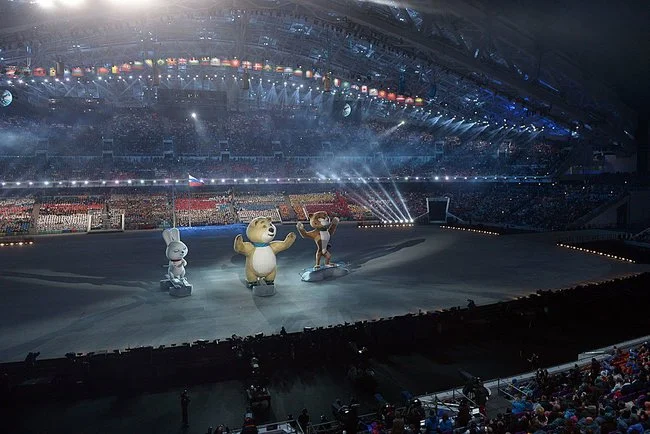
Read MoreIn my new novel “Water Music,” the Summer Olympics in New York includes an opening ceremony as pretentious and ponderous as any of those sound and light shows that make up the actual opening ceremonies.
Let me ask you a question (or two or more): Why can’t the host country simply present its culture rather than hit us over the head with it? What did the opening ceremony for the Sochi Games really have to do with Russian culture? Why not an excerpt from “Swan Lake” or a clip from a film of “War and Peace”?
The irony of all these opening ceremonies is that they are supposed to celebrate the unique histories and cultures of the host countries, but they are actually interchangeable because they’re filled with faux PR symbolism. Enough with the cutesy mascots and whirling snowflakes and required releasing of a peace dove and that un-singable Olympic Anthem. Read more
Read More