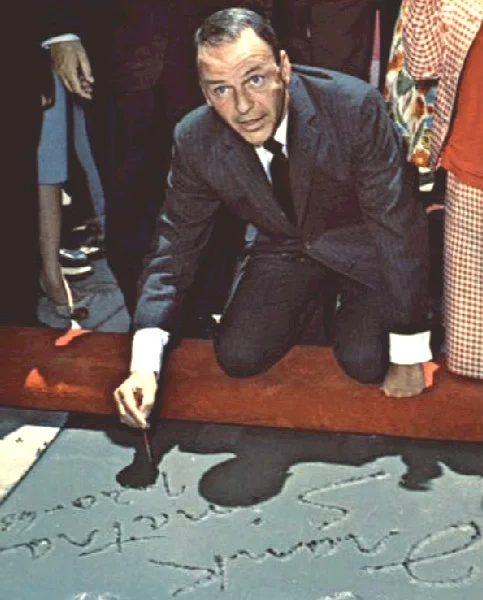
Frank Sinatra at Grauman’s Chinese Theatre in 1965
With virtually everyone weighing in on Ol’ Blue Eyes 100th birthday Saturday, Dec. 12, I thought I’d put in my two cents since I covered him live and from a distance for Gannett.
Any discussion of Frank Sinatra begins and ends with talent. His was deep, varied and wrapped in a complex personality. Begin with the Voice – distinctive, limpid and punctuated by the impeccable phrasing and superb breath control he learned from bandleader Tommy Dorsey’s trombone playing. Throw in his dancing – a talent people don’t generally associate with Sinatra. But his was fluid and fleet. (See “Anchors Aweigh” or “On the Town.”)
Then add his acting talent, which may have been overshadowed by his singing but was considerable nonetheless. In his Oscar-winning performance as the doomed Maggio, the kind of guy who always punched above his weight class, in “From Here to Eternity,” James Jones’ own “Iliad,” Frank was Patroclus to Montgomery Clift’s Achilles and Burt Lancaster’s Odysseus. But he was terrific in other roles, too, most notably as the disaffected soldier turned peacetime writer in Jones’ follow-up, “Some Came Running,” in which Sinatra starred with fellow Rat Packers Dean Martin and Shirley MacLaine.
Even when he was cutting up with his pals in Las Vegas, Sinatra remained a serious person in the sense of being receptive to ideas. He never sang anything that was meaningless or in a meaningless way. He championed the artistic aspect of films over the commercial one. Born in the Edwardian era, he painted on Sunday afternoons en plein air and encouraged Tony Bennett, now as accomplished an artist as he is a singer, to take up painting. He wrote letters, and lent his talents to presidents as different as John F. Kennedy and Ronald Reagan. He won an Oscar for taking on religious prejudice in the 1945 short “The House I Live In,” which seems even more pertinent today.
Sinatra had excellent taste, working with the best of composers, lyricists, arrangers and accompanists, all of whom he acknowledged in his performances. In an age in which people aspired to more than the newest technological device, he remained aspirational. He believed in being the best and gave the best. (See the show he organized for JFK’s inaugural.) And, most important, he reached out to those in need – like the Central Park jogger – immediately and generously.
But Sinatra was also a complicated man. He was both chivalrous to and exploitative of women, like many men in the “Mad Men” era. And he had a famously confrontational relationship with the press, although as he aged, he mellowed somewhat. Ask him a question and he would fax you an answer. I’ll never forget his tribute statement on the death of his second wife Ava Gardner. He really loved her.
The latter-day Frankie was a lion in winter. He’d forget the words to his songs. His voice grew patchy. But then he’d deliver a powerful “Bewitched, Bothered and Bewildered,” and the years would melt away.
The years: There have been lots of Sinatra tributes this week of varying quality. But I think the best is simply Frank singing “It Was A Very Good Year” by Erwin Drake, arranged by Gordon Jenkins. Here it is.
Enjoy and Frank, thank you for many very good years.