In a Jan. 11 New York Times article about Pope Leo XIV’s not-so-subtle messaging against the Trump Administration’s anti-immigrant, nation-grabbing agenda, there was one paragraph that stopped me cold:
“…Rather than viewing Leo’s statements as one half of a mano-a-mano between pope and president, they may be better seen as the articulation of a post-Trump global order, one informed by universal values and institutional norms rather than tribal and individual self-interest. Leo is not looking for a fight with Mr. Trump; he is looking past him. When he challenges the president’s policies, he does so as an American-born pope recalling the American-inspired system that Mr. Trump is dismantling — one that values statesmanship over gamesmanship, the common good over national conquest and common decency over jingoist bullying.”
We are in the region of ice – to borrow the title of a Joyce Carol Oates’ short story – and of ICE, the coming storm a metaphor for the heartless paralysis in which we find ourselves. Yet all is not lost. There are many ways to deal with a narcissist – head-on confrontation, which is an exit strategy; kiss up, kick down, the dishonorable method of sycophantic enablers; go along to get along with a secret agenda for the common good, the tricky double agent approach: or the deep freeze, a nerves-of-steel scheme requiring real leverage to hold the narcissist at bay by leading with a cold shoulder. (Call it the Melania.)
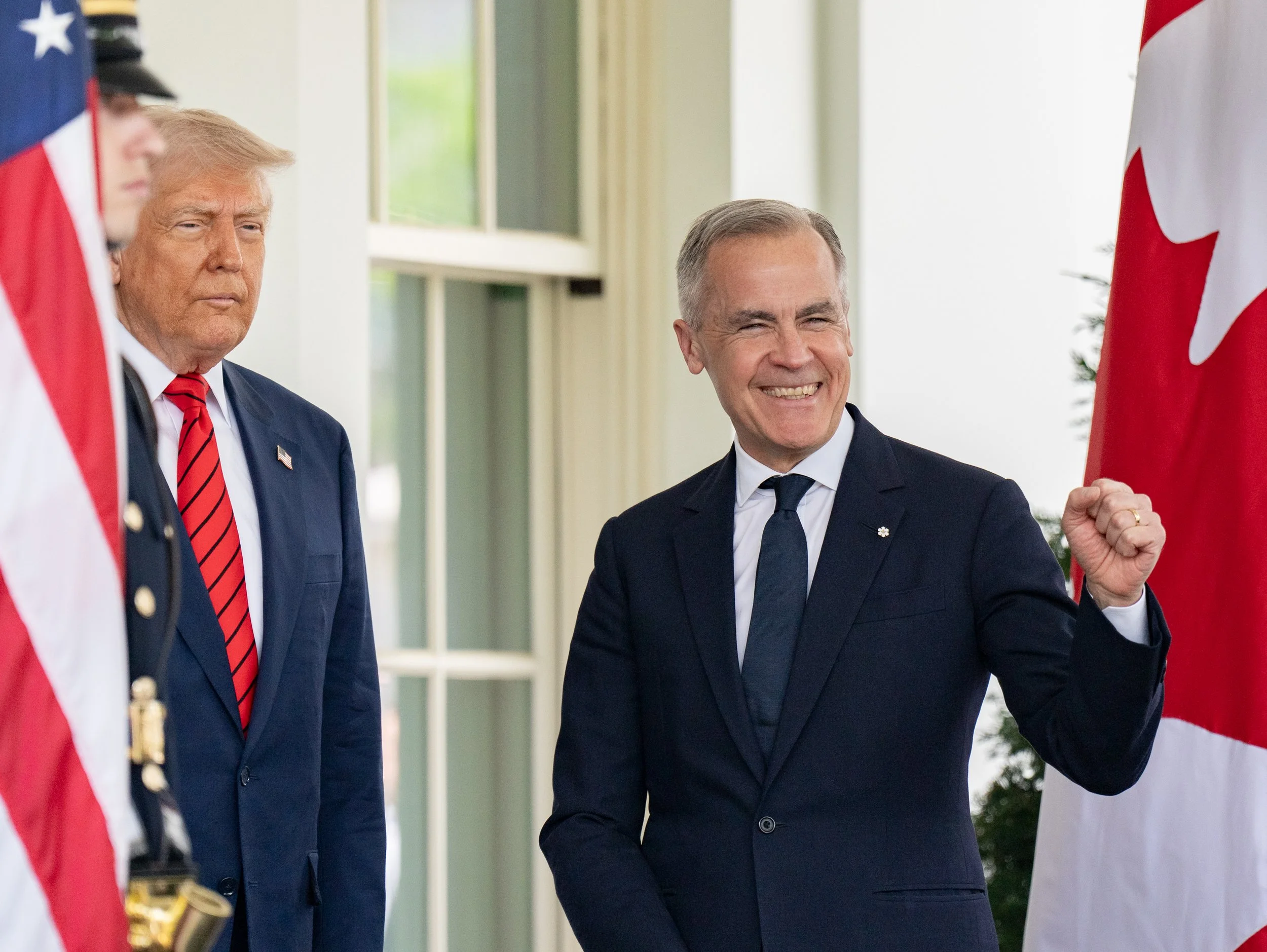
But there is another approach I had forgotten – to stand up to the narcissistic, bullying abuse and either directly (Canadian Prime Minister Mark Carney) or indirectly (Leo) announce that you are not going to stand for it and will build a world around, through or without the bully.
That’s what NATO is doing. That’s what the European Union is doing. That’s what Canada and Mexico are doing. That’s what the blue states are doing.
As much as I love podcasts like “The Bulwark,” “The Meidas Touch’ and Tennessee Brando – all of which have their place in keeping the resistance front and center – and as much as I am part of the mainstream media, I think they are susceptible to obsession and magical thinking, grasping at polls and health reports, anything really that shows them and us that the United States has turned a corner in our long national Trumpian nightmare.
But President Donald J. Trump was the voters’ choice. His base will never abandon him, and he in turn will never change his self-aggrandized, aggrieved approach to life. In many ways, it is a very American approach. From the beginning, we have seen ourselves as God’s country, the exceptional nation, the white hat riding in to save others.
That’s not only over; it was never really true. This isn’t the first time we’ve lusted after Greenland, though God knows why when we have a 1951 treaty saying we can build any military bases that we want there. It’s not the first time we’ve engaged with regime change in the Middle East or South America. Nor is it the first time that we’ve heard that but for us, Europe would be speaking German right now. (I grew up hearing that.)
Let’s be clear: After continental Europe came to our aid in the American Revolution, we incurred not just monetary debts but a blood debt, and a blood debt must be paid in this world. It cannot be denied, transferred or canceled. We owed Europe our help in World Wars I and II. Gen. John J. “Black Jack” Pershing said as much when he arrived in Paris at the head of the American Expeditionary Force in World War I and proclaimed, “Lafayette, nous sommes ici.” “Lafayette, we are here” – a reference to the dashing, tender young marquis who risked his life to fight in the American Revolution and became like a son to Gen. George Washington.
The French, the Spanish, the Dutch were there for us, no matter how mixed their colonial motives were. The British would develop a special relationship with us. NATO had our backs on 9/11. As for the Canadians, whose land Americans failed to conquer in the American Revolution, I always think of that moment in the long slog that was the Iran hostage crisis (1979-81) when Canada shielded six American diplomats, helping them escape. Afterward, there was an image in a newspaper of the billboard placed on the Canadian-American border – the longest natural border in the world – that showed a tiny Canadian flag in one corner and a tiny American one in another and in the middle only two words, “Thanks, Canada.”
Yes, thank you, Canada, for being there, for being a friend. Thank you to our other allies, too. But there can be no attitude of gratitude without remembrance, and lack of retention is basically lack of attention. It isn’t that Trump has forgotten the history of our country. It’s that he never knew it to begin with. People like to say you can’t know what you don’t know. No, you don’t remember what you don’t learn.
Time to call a spade a spade and move on, with the rest of the world. Time to stop target fixating, which occurs when you stare at an obstacle, rather than looking past it.
Time to open our eyes to see where we’ve been, where we are now – and where we want to be headed.