“I have always thought of Christmas time as a good time,” Charles Dickens writes in “A Christmas Carol,” “a kind, forgiving, charitable, pleasant time; when men and women seem by one consent to open their shut-up hearts freely, and to think of people below them as if they really were fellow-passengers to the grave, and not another race of creatures bound on other journeys.”
“Fellow-passengers to the grave”: That grave to which we all tend, death, really is another country, the undiscovered one “from whose bourn no traveler returns,” Shakespeare’s Hamlet observes in his “To be or not to be” soliloquy. But dying is something else again. That is part of living.
How do we die? The answer to that questions depends a lot on how we answer another: How do we live? Do we just exist, the slave to our basic needs and superficial values that make gods of money and power? Or do we try to fulfill our passions and dreams, not forgetting along the way at the very least to treat others with kindness?
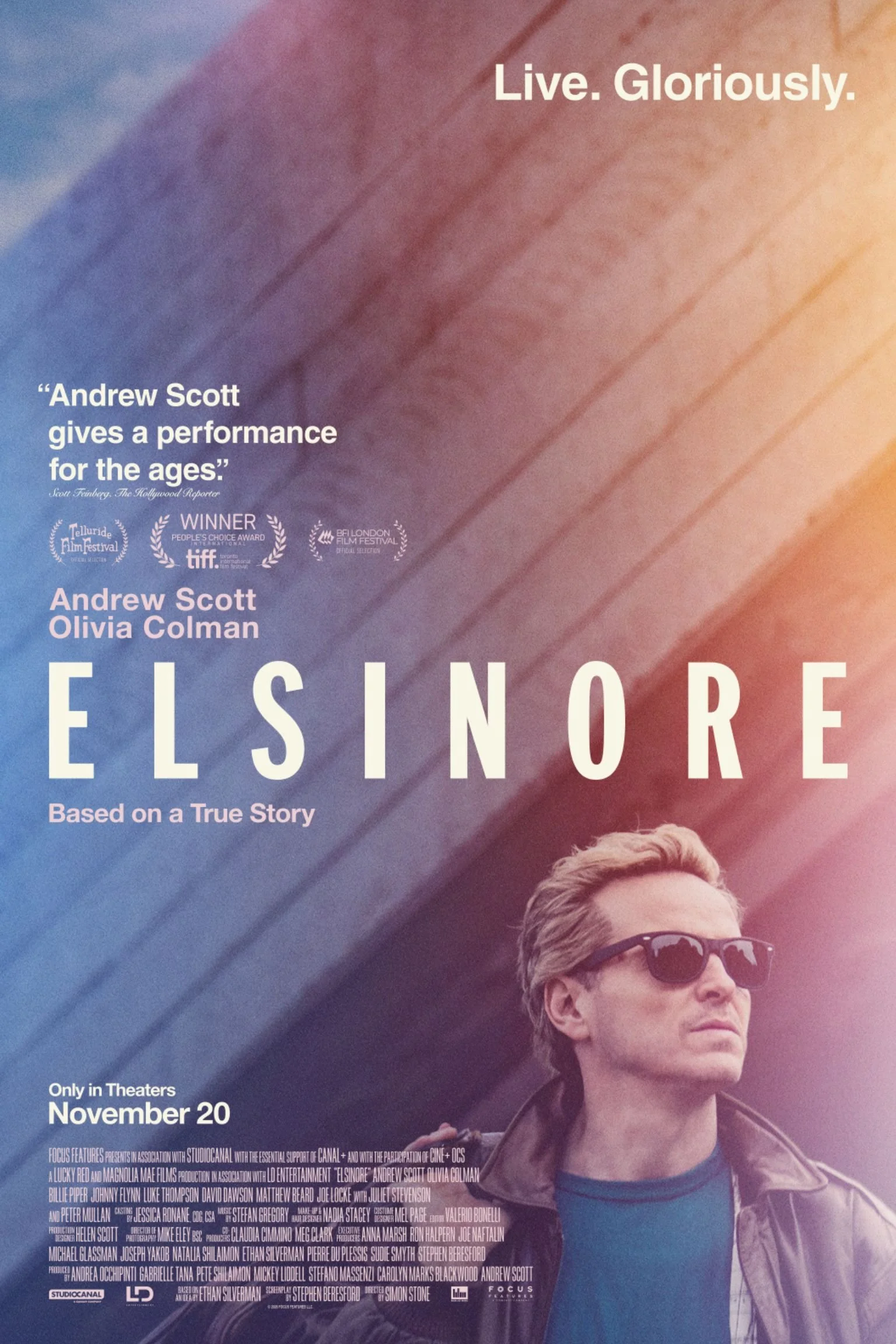
“Elsinore,” which goes into wide release Friday, Dec. 4, is the heartbreaking yet glorious story of one man’s decision to live the end of his life with purpose and joy — a story that will stay with you long after you leave the movie theater.
Scottish actor Ian Charleson’s HIV infection was already on its way to becoming full-blown AIDS in 1989 when he received the opportunity of a lifetime — to take over, to take on, the role of “Hamlet” after Daniel Day-Lewis exited the National Theatre in London’s production mid-performance, suffering what could only be described as a kind of breakdown. (The film — directed by Simon Stone with a script from Stephen Beresford — dispenses with this judiciously if also somewhat humorously in its opening moments, setting up the incident as a springboard into the story it will tell; omitting that understudy Jeremy Northam finished up Day-Lewis’ performance and that director Richard Eyre had already offered the part to Charleson once Day-Lewis’ contract ended.)
Given his condition, Charleson shouldn’t have even considered doing it, a perspective made clear in the film by his no-nonsense yet compassionate doctor, Margaret Johnson, a pioneer in AIDS treatment. But Charleson was interested in quality of life rather than quantity of days. “I wasted time and now doth time waste me,” he says in the film, quoting another Shakespearean character, Richard II. A star of the Oscar-winning “Chariots of Fire” and “Gandhi” whose movie career never progressed to leading man status, the film’s Charleson sees time running out literally and he’s determined to grab the brass ring with Hamlet, a role he had had an unsuccessful go at when he was in his mid-20s in 1974. (Never mind that he would perform brilliantly at the National as the male leads in “Guys and Dolls” and “Cat on a Hot Tin Roof.”)
Much has been made about the film as a reconsideration of the AIDS pandemic of the 1980s, one of several being released, and the need to make the most of your life. (See my story in the Westfair Business Journal Monday, Nov. 30, at westfaironline.com.) There’s also been a great deal of talk about Andrew Scott’s Charleson as a frontrunner for the Best Actor Oscar, deservedly so. Already he’s proved himself to be a good campaigner for his projects, charming his way with insight and humor around the talk-show circuit.
But part of the beauty of his “Elsinore” performance and the film as a whole is the way it explores work as a key to identity and a life bound for glory. In her book, “The Human Condition,” philosopher/political theorist Hannah Arendt wrote:
“Work and its product, the human artefact, bestow a measure of permanence and durability upon the futility of mortal life and the fleeting character of human time….The task and potential greatness of mortals lie in their ability to produce things — works and deeds and words — which would deserve to be at home in everlastingness, so that through them mortals find a place in a cosmos where everything is immortal except themselves.”
Charleson wanted to find such a place and if he had to go through the hell of pneumonia, chemotherapy, weight loss, skin lesions, vomiting and exhaustion as well as keep his gayness in the closet to arrive there, well, then, so be it. Scott makes Charleson’s ambition, which never veers into ruthlessness, a thing of beauty, humor, poignance and desperation. Here the scenes with provocative director-activist Derek Jarman (David Dawson), who berates Charleson for not coming out, and friend Sean Mathias (Matthew Beard) really crackle as Scott reveals how bound up Charleson’s identity is with his job as an actor and the play “Hamlet” and how heavily the unfulfilled promise of his movie career weighs on him.
And here director Stone’s montage-like narrative style — which juxtaposes “Hamlet” as a story of “being alive and becoming dead” with Charleson’s struggles — and Stefan Gregory’s upwardly spiraling score, which have been criticized by some reviewers for hampering the story line and Scott’s performance, instead buoy them. For in the end, “Elsinore” has much in common with “Gladiator,” “I Play Rocky” or any sports movie, and that is as the story of a would-be star, down on his luck, who overcomes seemingly insurmountable hurdles to achieve epic existentialism, thanks to his inner spirit and a great supporting team. (A word on the supporting cast: It is a superb group, with nary a false note from Olivia Colman as Johnson, Johnny Flynn as Eyre and especially Billie Piper as casting director Patsy Pollock, the best friend who cared for him to the end.
Ultimately, it is Scott’s show and as he demonstrated earlier this season off-Broadway in “Sea Wall” and elsewhere he is a once-in-a-generation talent whose capacity to be emotionally naked on stage and screen is unparalleled. (The only other performance I’ve seen come close to that kind of rawness this year is Sam Reid’s Vampire Lestat in the AMC series of the same name.)
The moment where Scott’s Charleson chokes up as he tells his friend Sean that he “wanted the movies” or keeps smacking his head as he tells his mother how sorry he is are almost unbearable to watch.
No less impressive are the scenes in which Scott channels Charleson’s Hamlet for the play within the film. Scott offered an acclaimed but very different, conversational interpretation of Hamlet in the Almeida Theatre’s 2017 contemporary production. Here in a more traditional, classical interpretation, Scott makes clear how and why Charleson would be cited among the greatest interpreters of the role.
In plumbing how we live and die, “Elsinore” makes the case for a greater understanding of the nature of success. Charleson never became the movie star Day-Lewis did, but had he done so, he probably wouldn’t have starred at the National and gone on to become what Ian McKellen called the best Hamlet he ever saw. (Day-Lewis would never perform onstage again.)
We are limited creatures and our time on the world stage is even more limited. We are also such stuff as not only our dreams are made of but our choices, temperaments and destiny. “Comparison,” as President Theodore Roosevelt noted, “is the thief of joy.” Better as Hamlet says, as Charleson tells his doctor in yet another quietly moving moment, to “let be.”
As for the rest, well, it really is silence.