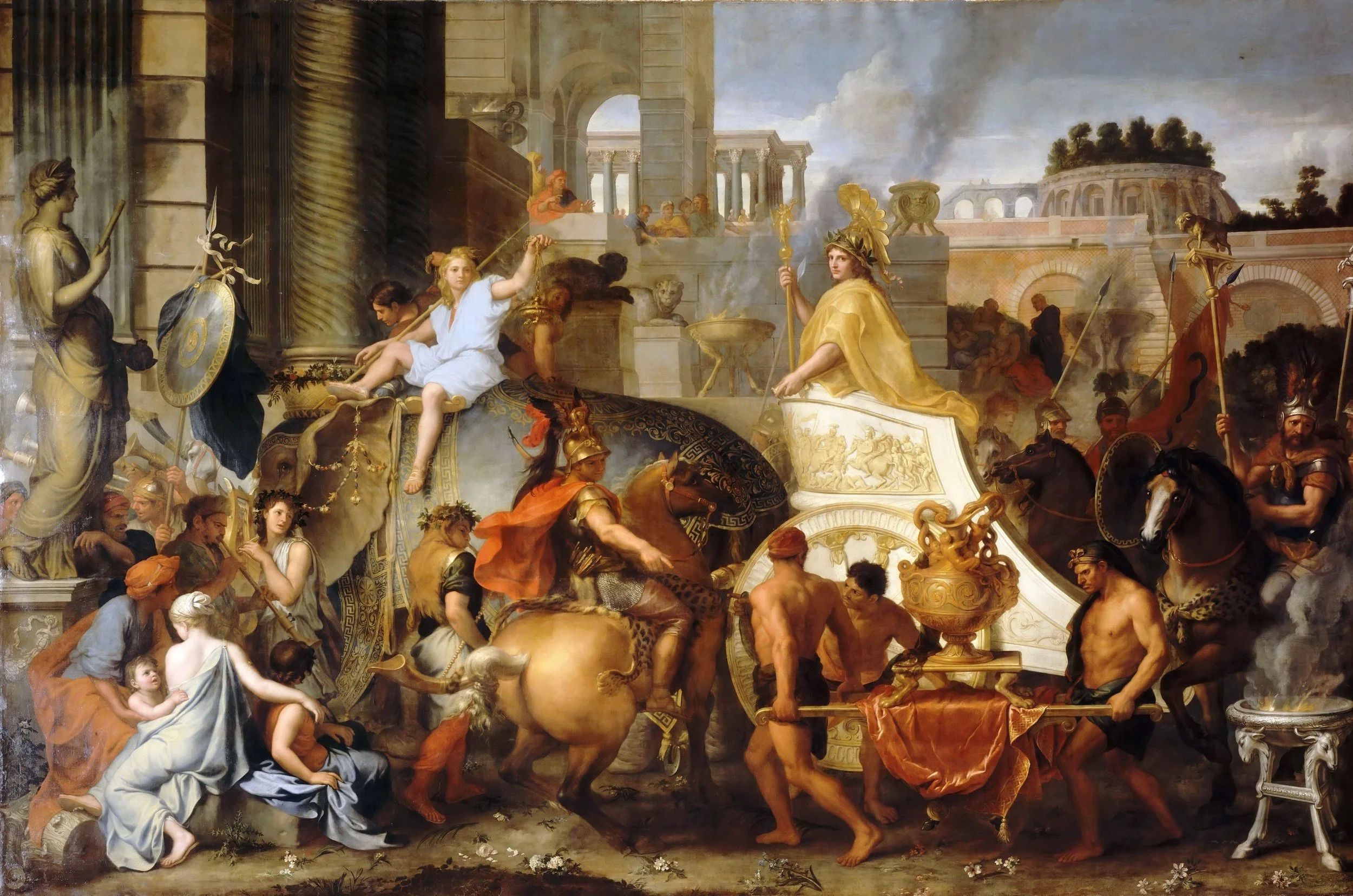
Some 23 years ago, at the start of the Iraq War, I was senior cultural writer for Gannett Inc., writing a story about the nature of leadership and interviewing, among others, New York City developer Donald J. Trump, who had agreed to answer some questions by email. At the time, Trump owned the Trump Taj Mahal in Atlantic City, New Jersey, which featured the $10,000-a-night Alexander the Great suite.
Alexandrian that I am, I was intrigued and began by asking him why Alexander? “Because he was the best, and it’s the best,” Trump wrote back.
I was reminded of that the evening of Friday, May 1, as I watched Ashley Parker, a staff writer with The Atlantic, discuss “The Yolo Presidency,” an article she co-authored, on PBS’ “Washington Week with The Atlantic,’’ about how President Trump aspires to be a great man affecting history in the spirit of Alexander, Julius Caesar and Napoleon and, especially in19th-century German philosopher Georg Friedrich Wilhelm Hegel’s interpretation of the “Great Man Theory.”
Hegel held that the trio named above were among those world leaders who acted as global change agents in ways they couldn’t have begun to imagine. Thus, while they may have been serving their own ends, including their ambitions of nation and empire, what they were really doing was serving a world spirit or geist.
I’m no expert on Hegel; Napoleon, who lost not once but twice to the British; or Caesar, whom Trump resembles in many ways. But I do know a lot about Alexander and Alexander as an change agent, and so I will speak to that.
To paraphrase Lloyd Bensen’s famous retort to Dan Quayle in their 1988 Vice Presidential Debate: “I know Alexander. Alexander was a child hero of mine. Donald Trump is no Alexander the Great.”
I say this not to denigrate the president or exalt Alexander. But rather I speak from a knowledge of history’s complexities. I do think Trump is a change agent in ways that we do not yet understand and that may not be apparent for centuries. I also think that given his personality, he would not see himself as a change agent in service of something larger than the MAGA-verse, which is not what Hegel had in mind.
It’s easy to understand Alexander as a change agent in service of the world spirit. Before Alexander (356-323 B.C.) conquered the Persian Empire in 331 B.C., creating an empire that stretched 22,000 miles from the Balkans to the Indus Valley, culture flowed East to West. After, it flowed West to East. In disseminating the Greek language and culture, Alexander unwittingly paved the way for the later translation of the Gospels into Greek and their spread throughout the Roman Empire. No Alexander, no easy transport of the teachings of Jesus Christ, a Greek name. I have interviewed scores of classicists on this subject, and on this they all agree.
But while Trump may admire Alexander, and Secretary of Defense Pete Hegseth may have been appointed to that post in lofty Alexandrian terms, Alexander was a league apart.
First, Alexander never lost a battle. Whereas the United States has lost the Vietnam, Afghan and Iraq wars, although we could count Iraq as a draw, like the Korean Conflict. And it’s a truth universally acknowledged – sorry, Jane Austen – that we’re on the verge of losing the Iran War, if we haven’t already done so. German Chancellor Friedrich Merz’s frank acknowledgement of such may have cost him 5,000 of the American troops stationed in Frankfurt in the manner of a typical Trumpian, narcissistic vendetta. This doesn’t, however, make Merz’s assessment of our current situation any less true. (For insight into our troubles in the Middle East, I recommend Frank L. Holt’s “Into the Land of Bones: Alexander the Great in Afghanistan.”)
Second, Alexander had a far greater understanding of the Other. Unlike his famous tutor, Aristotle, Alexander didn’t see the Persians as barbarians. He liked and admired a sophisticated people who gave us garden rilles, parasols and the word for “paradise.” More important, he let the diverse people of that empire maintain their own administrators, customs, cultures and religious practices, even as he established one currency and one lingua franca. It wasn’t because Alexander was a “We Are the World” kind of guy, but because he needed the empire to run smoothly. You don’t fix what isn’t broken.
In doing so, did he go native? In his book “Alexander: The Ambiguity of Greatness,” Guy MacLean Rogers argues that the more he conquered, the more he was seduced by the East. Alexander adopted Persian customs, took Persian wives, encouraged his men to do the same and planned to integrate his army as he turned his attention to Arabia and Rome, the latter then a backwater. Under such a one-world vision, the Greeks and Macedonians who had shared in Alexander’s victory understandably chafed, ultimately curtailing his vision before he died in Babylon on June 10 or 11, 323 B.C., a month before his 33rd birthday. But there is no question that Alexander was a conqueror-explorer without borders.
Third, Alexander may have been an autocrat but he was no narcissist. Alexander was an autocratic king descended from many autocratic kings in a pre-Christian age in which your chief accessory was the dagger you kept under your pillow. But that doesn’t mean he didn’t know who he was. Asking the philosopher Diogenes if he could do anything for him, he took it in stride when Diogenes, who did not suffer fools gladly, said, “Yes, you can move. You’re blocking my light.” Similarly, when he asked the defeated Indian King Porus how he wanted to be treated and heard the cheeky answer, “Like the king that I am,” Alexander obliged him.
When Alexander learned that his great opponent, Persian Emperor Darius III, had been betrayed and murdered, Alexander avenged Darius’ death, gave him an imperial funeral and adopted the imperial family as his own. Surely, it was the way to establish his own legitimacy. But it was also a signal to the world that what the playwright Aristophanes said was true: “You know yourself in an adversary.” A rival, an opponent, an antagonist needn’t be an enemy.
Alexander could respect his adversaries, he could allow the talents of others to shine, because, flawed as he was, he understood the Greek maxim: “Know thyself.”
I don’t think we can say the same.