Sometimes you can say the right thing – the “true” thing – and still be wrong.
So we have Israeli Prime Minister Benjamin Netanyahu on the limits of Jesus Christ and actor Timothée Chalamet on the limits of ballet and opera. Both offered a realistic assessment of the world as it is. But both failed to see the world beyond its limitations.
In a March 19 press conference, Netanyahu, enraged some Christians, including those in the MAGA-sphere, when he said, “history proves that, unfortunately and unhappily, Jesus Christ has no advantage over Genghis Khan,” a remark that Iran immediately pounced on to divide a wedge between Israelis and the predominantly Christian United States.
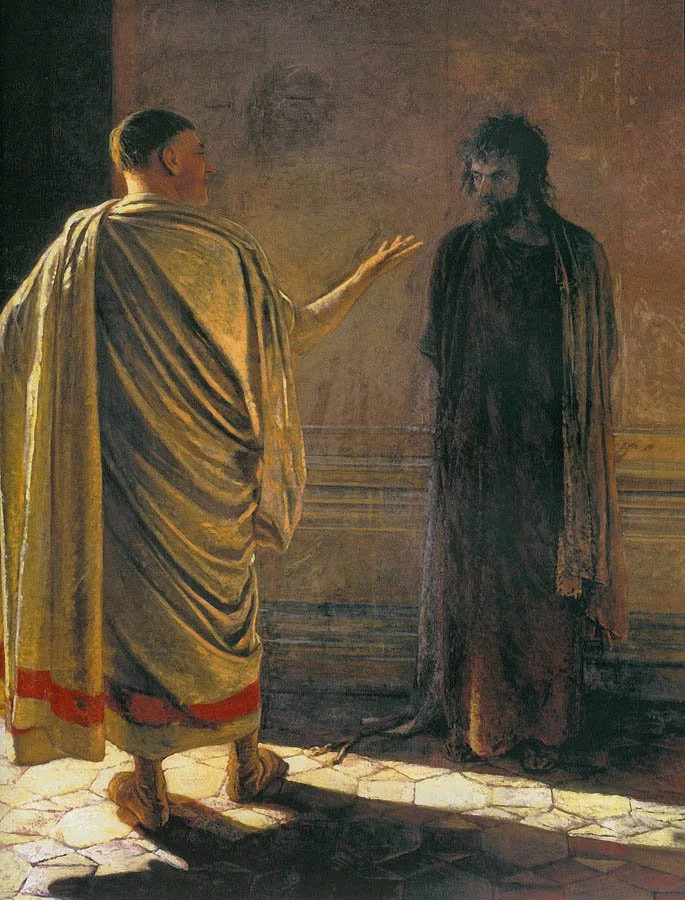
Ironically, Jesus may have agreed with him. In his encounter with Pontius Pilate, the Roman governor of Palestine, after he was arrested – events that will be commemorated on Good Friday, (April 3 this year) – Jesus said: “‘My kingdom is not from this world. If my kingdom were from this world, my followers would be fighting to keep me from being handed over….But as it is, my kingdom is not from here” (John 18:36-38).
John writes that Pilate asked him, ‘So you are a king?” Jesus answered, “You say that I am a king. For this I was born, and for this I came into the world, to testify to the truth. Everyone who belongs to the truth listens to my voice.”
That message spread as the Gospels were disseminated through the Hellenistic (Greek-speaking) world after Alexander the Great’s conquest of the Persian Empire. Jesus may not have had the military might of the 13th-century Mongol conquerer Genghis Khan, who ruled an empire four times the size of Alexander’s, but he had the more enduring message. Who in our undereducated world has heard of Genghis Khan today? In contrast, thanks to Greek culture and especially some wealthy Jewish women who backed the new Judeo-Christian sect, Christianity conquered the Roman Empire and is still thriving today. Indeed, Christianity’s message of a personal God who died for love of each individual, proves what President John F. Kennedy so shrewdly observed: “Nations may fall, men may die, but an idea lives on.”
And that was what was missing from Netanyahu’s message. Might may conquer today and tomorrow, but it will not conquer forever. It cannot conquer love, what author Thornton Wilder called, “the only meaning.” That is the message of Passover. That is the message of Easter, that love is stronger than anything, even death.
Similarly, Chalamet may have been as right as Netanyahu when he said ballet and opera are irrelevant and unpopular, but that is not the material point. They’re not unpopular, because they aren’t beautiful and haven’t strived for relatability in our dumbed-down digital culture. They’re unpopular, because we have a stupid, undereducated, lazy populace that is the result of an educational system that has thrown the arts and humanities under the proverbial bus in the name of both political correctness on the left (none of those dead white male figures) and fear of sexuality on the right (none of those provocative works).
The result is a society whose graduates are educated primarily in “useful,” job-friendly STEM, although those jobs are going the way of AI. I’d be gloating about this, except that it has led to the lack of Alexandrian leadership (leadership from the front) and in this and other ways costs us all.
I recently wrote a freelance piece on the American Revolution in which the publisher told me that she had to “soften” it, because a social media person objected to the use of the word “revolution.” It’s not bad enough that the social media person was so uneducated as to object to the use of the word “revolution” in a story about – wait for it – a revolution. It’s that the publisher didn’t stand up for the story, because it’s all about the company for which she edits the magazine – in other words, the money.
“All that’s necessary for evil to triumph is for good men to do nothing”: It’s a saying that’s been attributed to several sources. Whoever said it was a genius. It’s fine to tell it like it is. But unless we also offer an alternative ideal to strive for, as Jesus did, we risk giving voice to a self-fulfilling prophecy of conquest, despair and nihilism.