As a collector of “Wuthering Heights” interpretations —Emily Brontë’s novel being the inspiration for my revenge family drama “Seamless Sky” — I was intrigued then disappointed by the announcement of a new film adaptation. I haven’t seen it, but what I have seen of it makes me think Margot Robbie is all wrong for the part of Cathy, not the least of which being that she’s a blonde.
The fair Ralph Fiennes and the French Juliette Binoche would’ve seemed all wrong for the 1992 film “Emily Brontë’s Wuthering Heights.” But they have such talent and chemistry that they are among my favorite Cathys and Healthcliffs, never more so than in their scenes on the Yorkshire moors where their perverse, almost Luciferian defiance of everything and everyone but themselves and the natural world sows the seeds for their haunting, destructive story arc.
Here Fiennes wears his hair long and dark, and that matters, because Brontë contrasts Healthcliff and Cathy’s darkling Dionysian fire with the frosted Apollonian light of “the Linton Angels,” Edgar and Isabella, the heir to Thrushcross Grange and his sister, whom Cathy and Heathcliff will marry and destroy. Dark and light, nature and civilization: It is a brilliant conceit of the novel that however cruel Cathy and Heathcliff may be, the snobbish, judgmental world of the Lintons, albeit refined, offers its own kind of monstrosity, made all the more terrible by its hypocrisy.
Of course, it is popular nowadays to say that Heathcliff is not physically dark enough, that he is really Black. (A 2011 adaptation featured James Howson, the first Black actor to play Heathcliff.) I have nothing against color-blind casting, but did Bronté intend for Heathcliff to be Black? She describes him as “a dark-skinned gipsy” (Roma) in aspect, with black hair and eyes, who turns pale at times.
This could suggest someone of African, Indian, Black Irish, Spanish, American or mixed race descent, scholars have said. It is a description designed to conjure the Otherness of orphans trying to survive on the streets of Liverpool, where Mr. Earnshaw finds a filthy, ragged child and brings him home to be a brother to daughter Cathy, who ultimately regards him as a soulmate, and son Hindley, who sees in him a rival to be abused and debased, particularly after Earnshaw dies.
Despite being named for Earnshaw’s dead son, Heathcliff has no surname and thus no enfranchisement and inheritance, in the manner of slaves. He is simply Heathcliff, which further underscores his uniqueness and otherworldly, changeling aspect in what is a Gothic narrative.
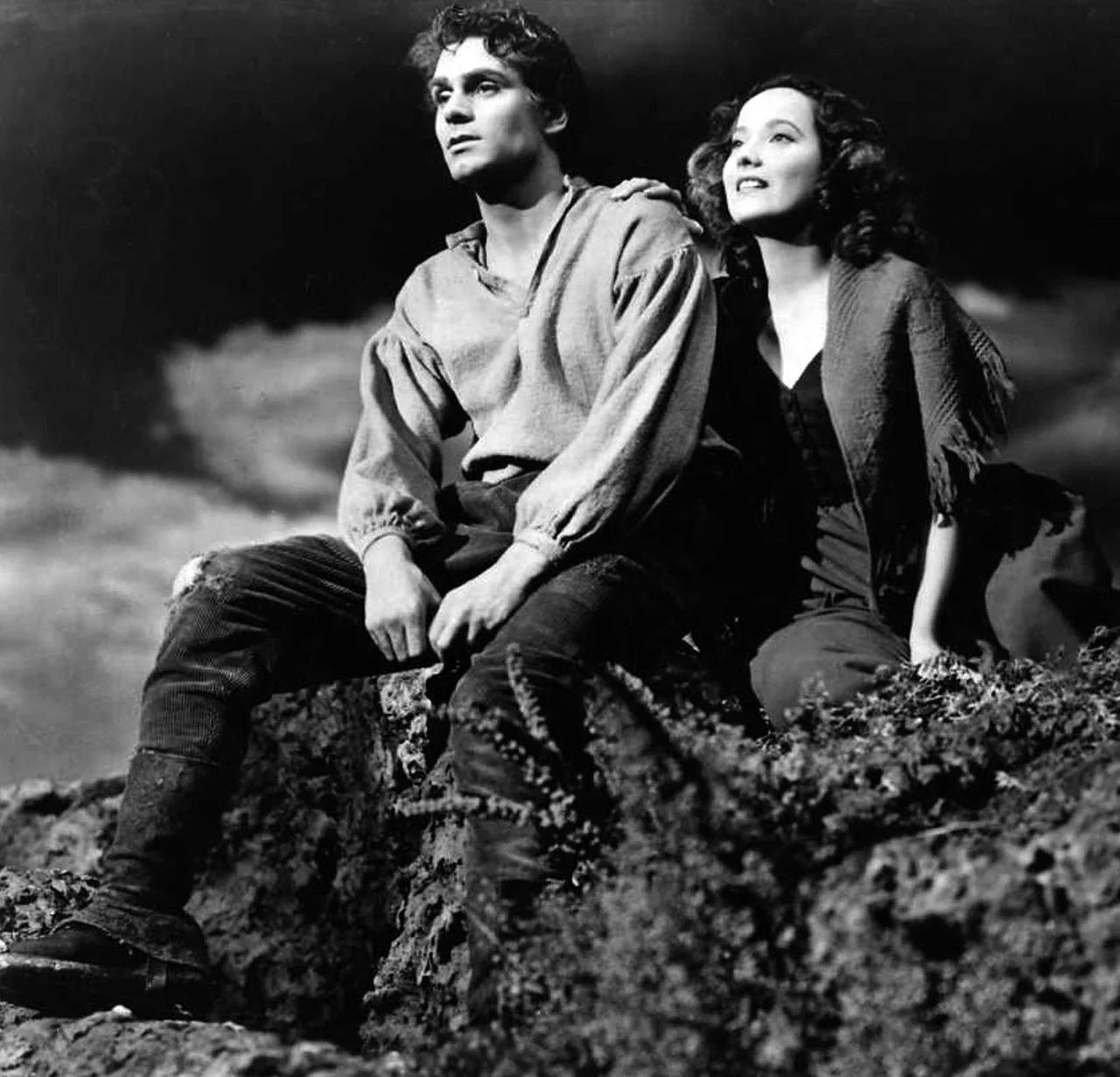
Of course, having a minority actor play Heathcliff would reinforce that Otherness, but it could do so in a way that reinforces the stereotype of minorities as unworthy of trust. Indeed, the poster for the 1939 movie shows a startled Merle Oberon — herself of Anglo-Indian descent, a fact that was hidden from the public — in white with a dark-skinned Olivier in black lurking behind her, as if this were a conventional horror story and Heathcliff merely a villian.
Is Heathcliff evil? I had this conversation with Fiennes, who told me he saw Heathcliff as an antihero, a man made monstrous by the abuses of his childhood. I think that’s spot-on. Heathcliff is as much sinned against as sinner, with Cathy’s betrayal of him for the society of the Grange perhaps the greatest misery he endures. Cathy lives in the delusion that she can retain her bond with Heathcliff, raising him up by aligning herself with the material world she craves, even though the gateway to that world, Edgar, is as different from Heathcliff as “frost from fire.” For someone who famously says, “I am Heathcliff,” Cathy misjudges the tideless deep of his connection to her, because she misjudges the tideless deep of her connection to him. She fails to realize that while you can take the girl out of the Heights, you can’t take the Heights out of the girl.
Whereas whatever he is, Heathcliff is true to himself, to Cathy and the private world they created for themselves on the Heights. Bur he cannot accept that that world has changed, that she has changed and separated her identity from his to an extent. In this, he cannot transcend. Like Dante’s Satan, he becomes encased in a stasis that can only lead to revenge and catastrophe.
There are lots of people like the main characters in Charlotte Brontë;s “Jane Eyre” — the mousy, underrated governess and the arrogant guy who makes a mistake with a woman early in life and then pays and pays and pays for it. But in sister Emily’s tale of possession and dispossession — one witty critic described it as a novel about real estate and inheritance — Cathy and Heathcliff are not like anyone you know. Indeed, if you lived next door to them, you’d go running from your house but not before posting a “For Sale” sign on your property.
What makes Cathy and Heathcliff so unusual? The book “Fetishes, Florentine Girdles and Other Explorations Into the Sexual Imagination” (HarperPerennial, 19943), edited by Harriett Gilbert, suggests that they’re not meant to be people at all but a metaphor for Brontë’s love of God and longing for the afterlife with him.
It quotes what is perhaps her most famous poem, “No Coward Soul”:
“O God within my breast,
“Almighty ever-present Deity!
“Life, that in me hast rest,
“As I, undying Life, have power in thee!”
However, for Camille Paglia, author of “Sexual Personae: Art and Decadence from Nefertiti to Emily Dickinson” (Vantage Books, 1991), Bronté’s Heathcliff is a mash-up of Lord Byron and herself. If that’s the case, might we consider Charlotte to be Emily’s Cathy?
The fiercely private, independent Emily had a loving but complex relationship with her ambitious, social older sister. (Emily was closer to their young sister, Anne.) Like Cathy, Charlotte hungered for a material success designed to raise her author-sisters up as well. Like Heathcliff, Emily remained attached to the world of their Haworth Parsonage childhood and the storytelling that began there and needed no other audience.
When Emily died — only calling for a doctor when it was too late — Charlotte began the mythologizing of her sister, trying to turn her into a softer, more conventional figure.
But Emily needs no mythologizing and no apology. She remained true to who and what she was. For her, as for her Heathcliff, there was only the moors.